
Thermostat & temperature control issues
Thermostats, sensors, or control logic can keep the water heater from holding the right temperature or cause water to be too hot or too cool.
When your water heater is not making hot water, leaking, making noise, or struggling to keep up with the household, All Year Heating & Air can help diagnose the problem and explain practical water heater repair options.
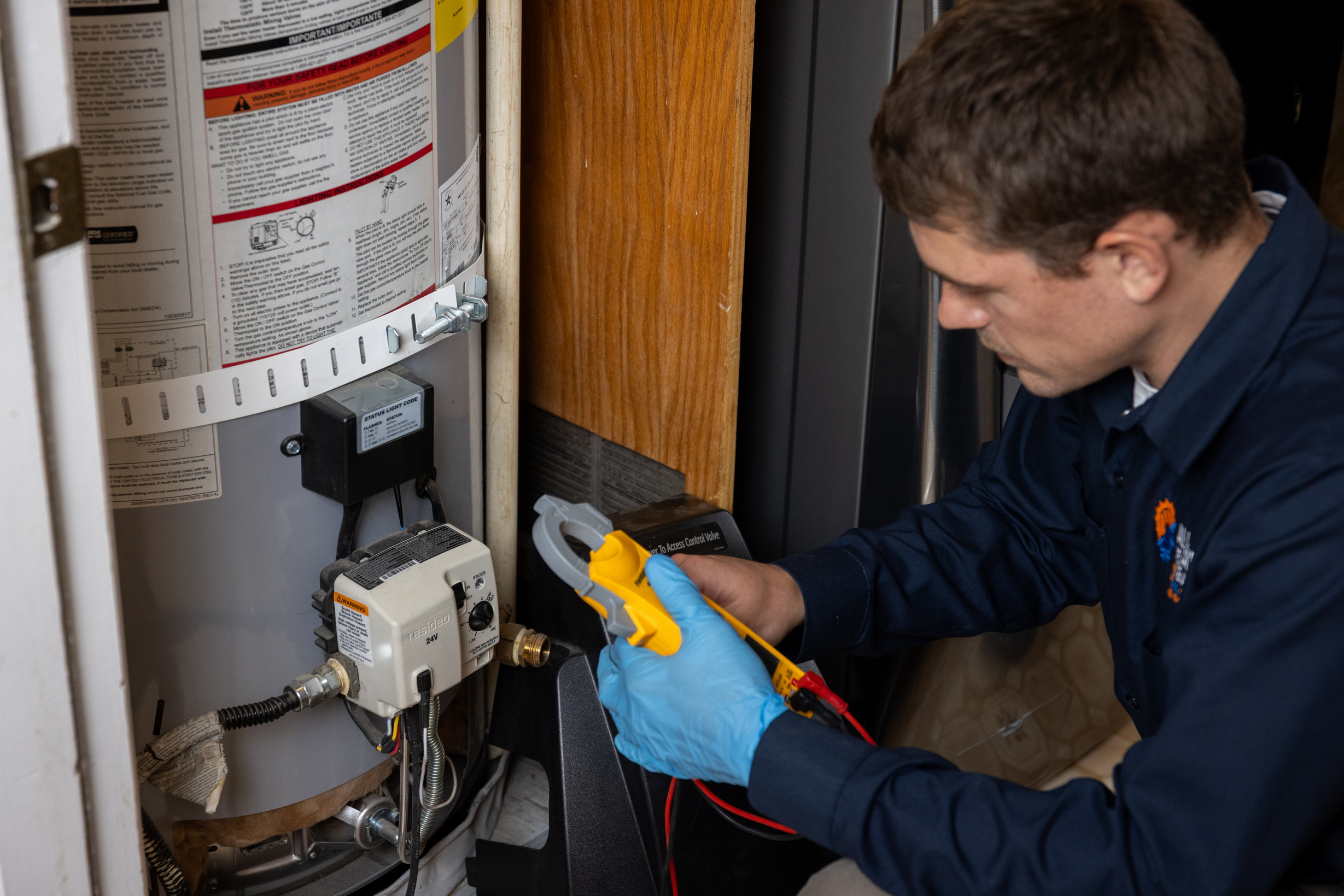
A water heater problem rarely stays small. No hot water disrupts the household. A small leak can become flooding. Sediment can affect heat output. And gas, electrical, and pressure-relief symptoms can become safety concerns. The safest next step is a professional diagnosis instead of guessing.
Safety first: If you smell gas, hear hissing near the gas line, see steam or hot water discharging from the pressure relief, or get scalding water at any tap, leave the area and call your gas or water utility's emergency line before anything else.
If the water heater is not making hot water at all, the issue may involve the pilot light, igniter, thermostat, heating element, gas supply, electrical supply, or a deeper water heater fault.
Leaks can come from connection fittings, the pressure relief discharge, the drain valve, sediment-related concerns, or — in some cases — the tank itself. Even small leaks should be checked.
Hot water that disappears quickly may point to thermostat settings, sediment buildup reducing usable capacity, dip-tube concerns, or a unit that no longer matches the household's demand.
Popping, rumbling, or banging from the tank is often associated with sediment buildup at the bottom of the water heater. Hissing or screeching may point to other issues that should be diagnosed.
Pilot light issues on gas water heaters may involve the thermocouple, gas supply, control valve, or related components. This work should be handled by a qualified service technician.
Scalding water at the tap can be a thermostat problem and a serious safety concern. Avoid using hot water at full strength until the issue is checked.
Discolored or odd-smelling hot water may be related to the inside of the tank, anode-related concerns, or the home's water supply. A diagnostic helps separate water heater issues from supply issues.
An electric water heater that keeps tripping the breaker may have a heating element, thermostat, or wiring issue and should be diagnosed by a qualified technician — not reset repeatedly.
Water from the pressure relief line can be normal occasionally — but persistent discharge points to pressure or temperature concerns and should be diagnosed before it gets worse.
If the water heater takes much longer than it used to to make hot water, the issue may involve elements, thermostats, sediment, or a system that's no longer matching demand.
Water heater problems can come from controls, thermostats, heating elements, gas-fired components, sediment, water supply, pressure relief concerns, or symptoms pointing at the tank itself. A diagnostic visit helps identify whether the issue is repairable and what next step makes sense.
Thermostats, sensors, or control logic can keep the water heater from holding the right temperature or cause water to be too hot or too cool.
Electric water heater symptoms often involve heating elements or related controls. Element work should be performed by a qualified service technician — not by a homeowner.
Pilot lights, igniters, thermocouples, and gas valves are common gas water heater concerns. This work involves gas safety and should be handled by a qualified technician.
Sediment at the bottom of the tank is a common cause of popping noises, slow recovery, and reduced usable capacity. We evaluate whether sediment is the likely cause.
Persistent discharge from the pressure relief valve can point to pressure, temperature, or expansion concerns. This is a safety component and not something to ignore.
A drain valve that drips, sticks, or leaks can be the source of a small water heater leak. We check connection fittings and the drain valve as part of the visit.
Cold-water inlet, hot-water outlet, and supply-line fittings can become a leak source. We evaluate visible fittings and explain the next step.
If the household is running out of hot water faster than before, we look at controls, sediment, settings, and whether the unit is keeping up with demand.
Rust-colored or odd-smelling hot water can point to issues inside the tank, anode-related concerns, or the home's water supply. A diagnostic helps separate the cause.
Steady leaks from the tank itself usually mean the water heater is reaching the end of its useful life. We say so honestly so you can plan next steps.
Safety note: Do not open the gas valve, relight a pilot you are not sure about, work around the gas line, work on heating elements or wiring, adjust pressure relief components, or attempt to drain or flush the tank yourself. Water heaters involve gas, electrical, pressure, and scalding-water concerns — let a qualified technician diagnose and handle the work.
For broader appliance support, visit our appliance repair hub.
"No hot water" is one of the most disruptive water heater problems in a home. Sometimes the unit looks like it's running but no hot water reaches the tap. Other times the pilot is out, a breaker has tripped, or the thermostat has stopped calling for heat. A short diagnostic separates the cause from the guesswork.
On gas water heaters, a pilot or igniter problem can keep the burner from firing — which means no hot water even though the unit looks fine.
A thermostat that has stopped calling for heat or is set incorrectly can leave the household with cool or lukewarm water.
On electric water heaters, an element-related symptom often shows up as no hot water or hot water that runs out very quickly.
If the gas supply to the unit has been interrupted, the burner cannot fire. This should be diagnosed and handled by a qualified technician — not investigated by the homeowner.
An electric water heater that has lost power may keep tripping the breaker, which usually points to a deeper issue. Repeatedly resetting the breaker is not a fix.
Heavy sediment can affect heating performance and make the unit struggle to deliver hot water at the volume the household expects.
If only one fixture has no hot water, the issue may be at the fixture. If the whole home is affected, the water heater itself is the more likely cause.
If the issue might be on the home's heating side instead — a furnace or HVAC system that affects warmth in the home — see heating repair or furnace repair.
A leaking water heater can damage flooring, drywall, cabinets, and nearby electrical components. Even a slow leak should be checked — sometimes it's a fitting, sometimes it's the pressure relief, and sometimes it's the tank itself reaching the end of its life.
Possible causes include:
If the leak is steady or growing: consider turning off the water supply to the heater if you know how to do so safely. If you're not sure, leave it alone and call a qualified technician. Avoid working around electrical components or gas connections during a leak.
A water heater problem doesn't automatically mean the unit needs to be replaced. Many issues are repairable when the tank itself is in good shape. In other cases, age, repeated failures, hard-to-source parts, or tank-side leaks may make replacement the more sensible conversation. We share what we find — you decide.
A diagnostic helps avoid guessing and gives a clearer repair-or-replace conversation before any decision.
Water heaters come in different fuel types, sizes, and configurations. When you call, describe what kind of water heater you have, where it's located, and what you're seeing or hearing so we can plan the visit before arriving.
Tankless, hybrid, point-of-use, and commercial water heaters: ask about availability when scheduling — coverage for these configurations should be confirmed for your specific unit.
A good water heater repair starts with a clear diagnosis. The goal is to understand the symptom, identify the likely cause, and explain practical repair options before any work begins.
We check the symptoms you reported — no hot water, leaks, noises, pilot/element behavior, recovery time — along with visible condition, fittings, controls, and the area around the unit.
You get a clear explanation of what we found, what may be causing the issue, and what repair options make sense. If replacement is the better conversation, we say so honestly.
If repair is practical, we work to restore reliable hot water. If further evaluation, replacement, or a specialist scope is more sensible, we explain that before moving forward.
All Year Heating & Air is built for homeowners, landlords, and property managers who want clear answers and respectful service. Whether the problem is a water heater, refrigerator, washer, dryer, dishwasher, AC system, or heater, the focus is practical diagnosis, clear communication, and service that fits the customer's situation.
Service focused on Santa Clarita and nearby communities.

Helpful for homes and rental properties that want one reliable service contact for both sides of the home.
We explain what we find before recommending next steps — no guess-and-replace.

We focus on repair when repair is practical and explain replacement only when it actually makes sense.
The service experience should feel professional, careful, and respectful of the home and the people in it.
Support for tenant coordination, repeat properties, and service documentation across rental homes and multi-unit properties.
For refrigerator, freezer, washer, dryer, dishwasher, oven, and stove repair support.
View appliance repair →For fridges that are not cooling, leaking, making noise, or warming up.
View refrigerator repair →For dryers that are not heating, not starting, making noise, or not tumbling.
View dryer repair →
For washers that won't drain, spin, fill, or stop leaking.
View washer repair →
If the home is cool overall — not just the hot water — start with heating repair instead.
View heating repair →
For gas furnace symptoms — pilot, igniter, blower, or short-cycling concerns.
View furnace repair →For water heater repair scheduling or availability questions.
Schedule service →Need a microwave installed or replaced? Help with over-the-range and built-in microwave installation.
View microwave installation →Real Google reviews from All Year customers. None of these reviews are specifically about water heater repair — they're shown as general trust proof. We'll feature water-heater-specific reviews here as they come in.
"If you want to get your problem solved you need to use this company and get the job done with great accuracy and great attitude. I've used them several times on different occasions and always been pleased and satisfied. Trustworthy, honest..."
"Great experience with All Year Heating & Air. The team was on time, professional, and fixed the issue quickly. Everything works perfectly now—highly recommend."
"Not only have they serviced our home, but all our rental properties as well. It's comforting to know you can trust a company to do quality work year after year."
Licensed & Insured — CA Contractor License #1103283 · Over 20 Years in Business
We provide Water Heater Repair across Santa Clarita Valley and the San Fernando Valley. Don't see your city? Call (818) 509-8486 — we may still serve your area.
No hot water can come from a pilot light or igniter issue, thermostat problem, heating element concern, gas supply issue, electrical issue, sediment buildup, or a deeper water heater fault. A technician can diagnose the cause and explain repair options.
A leaking water heater can come from connection fittings, the pressure relief discharge, the drain valve, sediment-related concerns, or in some cases the tank itself. Leaks should be evaluated promptly since water damage and tank failures can escalate.
Hot water that runs out quickly may be due to thermostat settings, sediment buildup reducing usable tank capacity, dip-tube concerns, heating element problems on electric units, or a water heater that no longer matches the household's hot water demand.
Popping, rumbling, or banging from a water heater is often associated with sediment buildup at the bottom of the tank. Hissing, screeching, or other noises may point to other issues. Persistent noises should be diagnosed before the situation gets worse.
Repair may make sense when the water heater is otherwise in good condition, the issue is isolated, and parts are available. Replacement may be worth discussing if the tank itself is leaking, repairs are frequent, the unit is older, or hot water performance keeps declining.
Yes. All Year Heating & Air provides water heater repair in Santa Clarita and nearby Santa Clarita Valley communities, including Valencia, Newhall, Canyon Country, Saugus, Stevenson Ranch, and Castaic. See full coverage.
Yes. All Year Heating & Air supports landlords and property managers with water heater repair needs, tenant coordination, diagnostic notes, and service scheduling for rental properties.
If you smell gas near your water heater, do not light any flames, do not switch lights or appliances on or off, and do not try to investigate the source yourself. Leave the home, then call your gas utility's emergency line from a safe location. Once the gas utility has confirmed the area is safe, call All Year Heating & Air to discuss water heater diagnostics.
You can confirm whether the water heater has power, whether other hot water fixtures in the home are also affected, and whether there is visible water around the unit. Do not open the gas valve, relight the pilot if you are not sure how, adjust the temperature past the manufacturer's recommended setting, or attempt repairs to gas, electrical, pressure relief, or tank components yourself.
Availability depends on schedule and service area. Call (818) 509-8486 to check the soonest available water heater repair appointment.
Still Have Water Heater Questions? Call Now Schedule Water Heater Repair
If your water heater is not making hot water, leaking, making noise, or struggling to keep up with the household, All Year Heating & Air can help diagnose the problem and explain practical repair options.
Serving Santa Clarita, Valencia, Newhall, Canyon Country, Saugus, Stevenson Ranch, Castaic, and nearby communities.
If you smell gas, see steam from the pressure relief, or notice scalding-hot water at the tap, leave the area and call your gas or water utility's emergency line before scheduling repair.